SOLD
Box written by Takeichi Kawai
Taisho
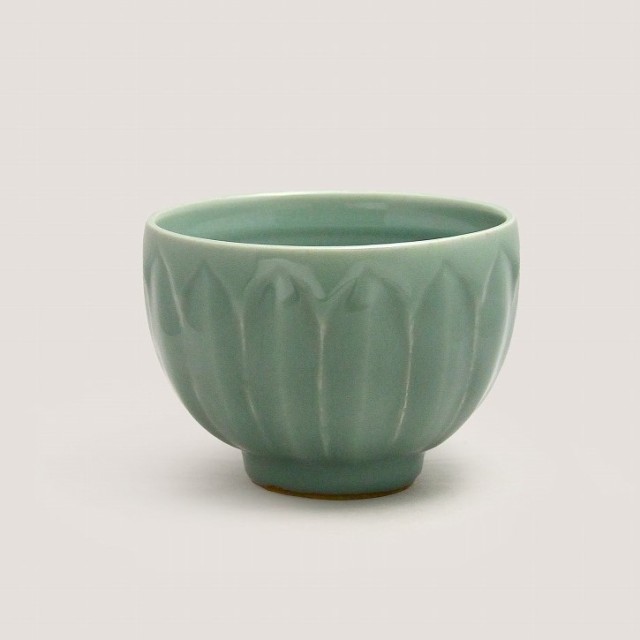
D16.5cm H12cm
These works were produced in his early period, before he joined the folk art movement advocated by Yanagi Muneyoshi, and were modeled after old Chinese and Korean ceramics. The high degree of perfection of his works at his first solo exhibition led to the acclaim and media coverage of his work as "a comet suddenly appeared," which made Kanjiro's name widely known. The mark of "鐘渓窯" can be seen on the bottom. The box is inscribed by Takeichi Kawai, a nephew of Kanjiro Kawai.
Kanjiro KAWAI
1890 - 1966
Kanjirou Kawai was a Kyoto-based potter within the folk tradition of Japanese and Korean ceramics and a key figure in Mingei (Japanese folk art movement). He was a long-time friend of Shōji Hamada, Soetsu Yanagi, and Bernard Leach with whom he co-founded the Japan Folk Art Association in 1926. He refused all official honors, such as the designation of “Living National Treasures,” He often decorated his works with bold, semiabstract blossom motifs, which he painted freely in under-glaze cobalt blue, iron brown, and copper red.
Contact about the Item