SOLD
with signed box
Showa
Living National Treasure
D7.5cm H14cm
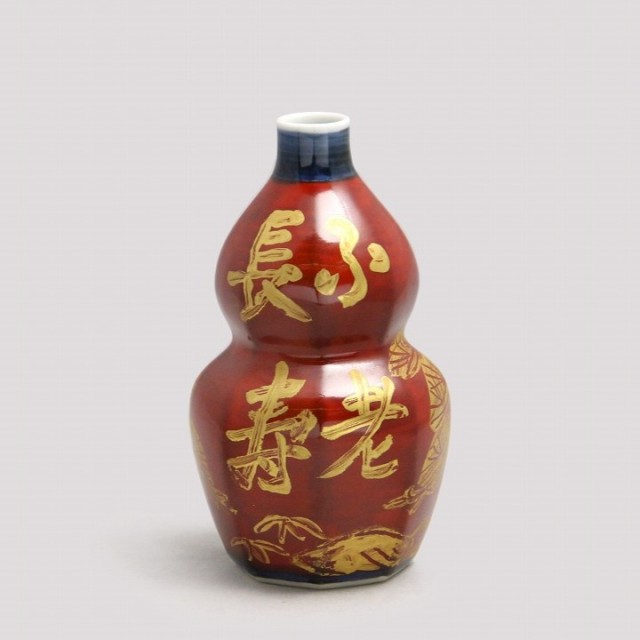
A refined porcelain sake flask with gilt decoration by Yuuzou Kondou, a Living National Treasure of Japan.
The deep crimson glaze is adorned with bold gold calligraphy reading “furō chōju” symbolizing eternal youth and longevity.
The gourd-shaped form, traditionally associated with good fortune and prosperity, enhances the auspicious character of the piece.
This exquisite work exemplifies Kondou’s mastery of glaze and elegant design, harmonizing traditional beauty with timeless sophistication.
Yuzo KONDO 近藤悠三
1902 - 1985
He was a Japanese potter. He was designated a Living National Treasure in 1977. He was from Shimizuderashita, Kyoto City. In 1914, he entered Kyoto Ceramic Experimental Station Attached Training Center. After graduating in 1917, he was hired as an assistant at the station. At the time, Kanjiro KAWAI and Shoji HAMADA graduated from Tokyo Higher Technical School and were researching ceramics, and Kondo learned ceramics engineering from Hamada. In 1921, he quit the experimental station and became an assistant to Kenkichi TOMIMOTO, who had just returned from England and opened a kiln in Yamato. He learned about groundwork and glaze technology as well as the spirit of ceramics art from Tomimoto. After returning to Kyoto in 1924, he studied sketches and western style painting at Kansai Art Academy and Western Art Research Institute, and established a kiln at Kiyomizu Shindo Ishidanshita. He was also presenting works of art of under glazed cobalt blue technique as well works using yuurikou and inlay techniques. In 1928, he won a prize at the 9th Japan Art Academy Exhibition (Teiten) for the first time, thereafter winning 13 consecutive times. He also presented many works at Bunten and other exhibitions. In 1950, he served as a judge at the 6th Nitten Exhibition. In 1955, he rejoined Nihon Kogeikai (the Japan Art Crafts Association). In 1956, he received the gold award for Japanese Traditional Crafts at the 3rd Japan Traditional Art Crafts Exhibition with his 'Sansui Dyed Pot.' He served as the executive director of the Nihon Kogeikai and chairman of the Ceramics Division. He taught as the assistant professor and professor in the Ceramics Arts Department, Kyoto City University of Fine Arts from 1953, became the professor in 1956. He received the Shiju Hosho (medal of honor with purple ribbon) in 1970, the Zui Hosho (Orders of the Sacred Treasure) and the Kyoto City Cultural Order Award in 1973. On April 25, 1977, he was designated as an important intangible cultural heritage (Living National Treasure) as the holder of 'sometsuke' skills. He was awarded the Medal of Honor in 1980.
Contact about the Item