SOLD
With Original Box
Showa Era
Living National Treasure
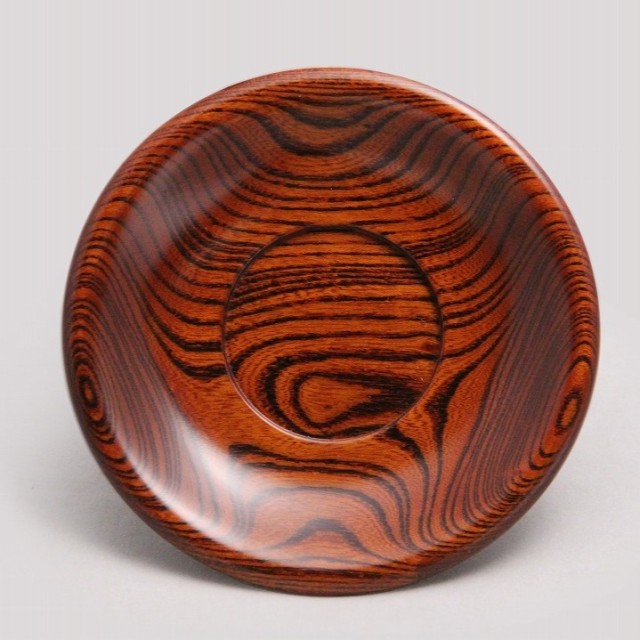
Diameter: 14 cm, Height: 2.5 cm
Kuroda's technique of urushi (lacquer) application involves an original method where the wood absorbs a generous amount of lacquer, achieving a glossy texture and a vivid wood grain pattern that stands out beautifully. Many of those who loved Kuroda's works, such as Masako Shirasu, Yasunari Kawabata, and Hideo Kobayashi, were said to have used them in their everyday life.
Tatsuaki KURODA
1904 - 1982
Born into a family of lacquer artisans in Kyoto. Questioning the division of labor in the process of lacquer application, he desired to create works that incorporated not only the final lacquer layers but also the creation of the base materials, leading him to pursue both woodworking and lacquer art. In 1924, at the age of 20, he was deeply inspired by a lecture from Kanjiro Kawai and joined the Mingei (folk art) movement led by Kawai and Soetsu Yanagi. Supported by clients in Kyoto, including the famous confectionery shop, Kagiya Yoshihou, he pursued his own unique artistic expression. Kuroda also had deep ties with influential figures such as Masako Shirasu, Naoya Shiga, and Yasunari Kawabata, and even received a request from renowned film director Akira Kurosawa to make chairs for his villa. In 1966, at the request of the Imperial Household Agency, Kuroda created door decorations, large display shelves, and chairs for the New Imperial Palace. Alongside these large-scale works, he continued to create small items like tea utensils and decorative boxes. In 1970, he was designated as a Living National Treasure (Holder of Important Intangible Cultural Heritage) for his mastery in woodworking. The following year, he was awarded the prestigious Purple Ribbon Medal in recognition of his achievements in traditional crafts.
Contact about the Item