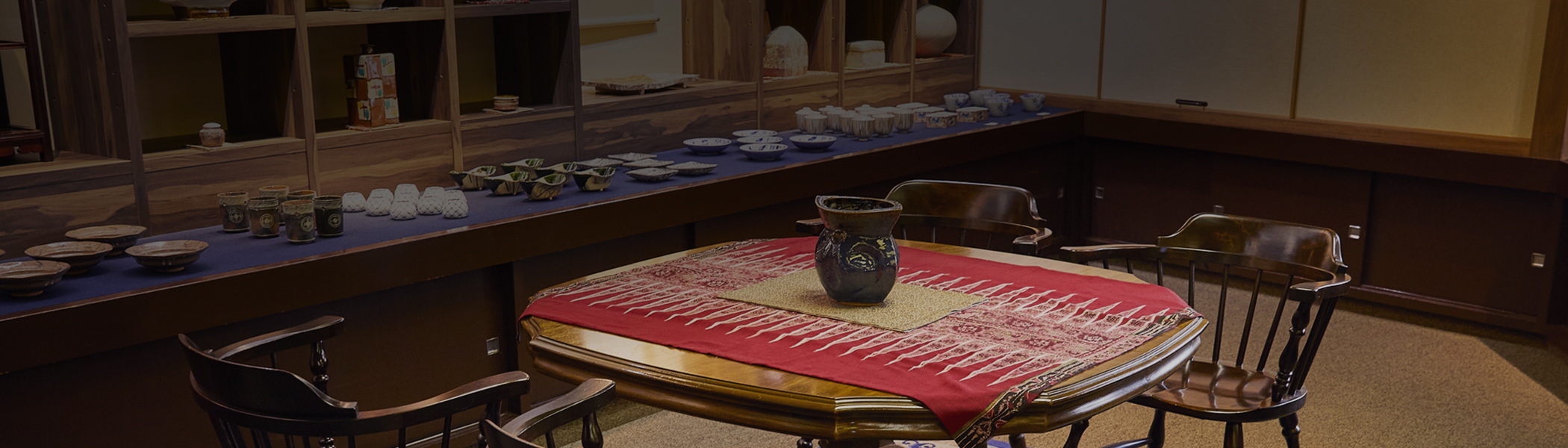
Mushiake-yaki is a type of pottery from Mushiake, Oku Town, Oku District, Okayama Prefecture. It originated during the Kansei era (1789–1801) as the official kiln of the Ikki family, the chief retainers of the Okayama Domain.
The first kiln was Seto kiln. Later, in 1819 (Bunsei 2), the Maguchi kiln was established, where the renowned potter Nonomura Ninsei also worked. This kiln was closed in 1842 (Tenpō 13).
In 1847 (Kōka 4), Ikki Sansansai invited the first-generation Kyoto potter Seifu Yohei to open the Maguchi kiln. The second-generation Yohei visited Mushiake in 1863 (Bunkyū 3) and fired a Mishima-style square water jar passed down from the tea master Sen no Rikyū on the 250th anniversary of his death.
Kazuyama Makuzu Miyagawa (the fourth son of the first-generation Nagazo) also came to this kiln in the early Meiji period and produced works mainly copying iron-painted “Gohon” pieces. Sansansai’s favorites included the famous “Twelve Months” tea bowls and tea bowls for the five seasonal festivals. In 1863 (Bunkyū 3), Sansansai handed over the Maguchi kiln to Morikaku Taro, who, along with his son Koshu, learned pottery techniques from Kazuyama. This kiln was also reluctantly closed in 1880 (Meiji 13). Thereafter, Koshu intermittently continued the work into the Taisho era. Koshu’s works mainly consisted of tea utensils, with the “Twelve Months” tea bowls and a Ninsei-style “Moon and Goose” fine water jar being well known. His seals include “Mushiake,” “Koshu,” and “Akeura.”