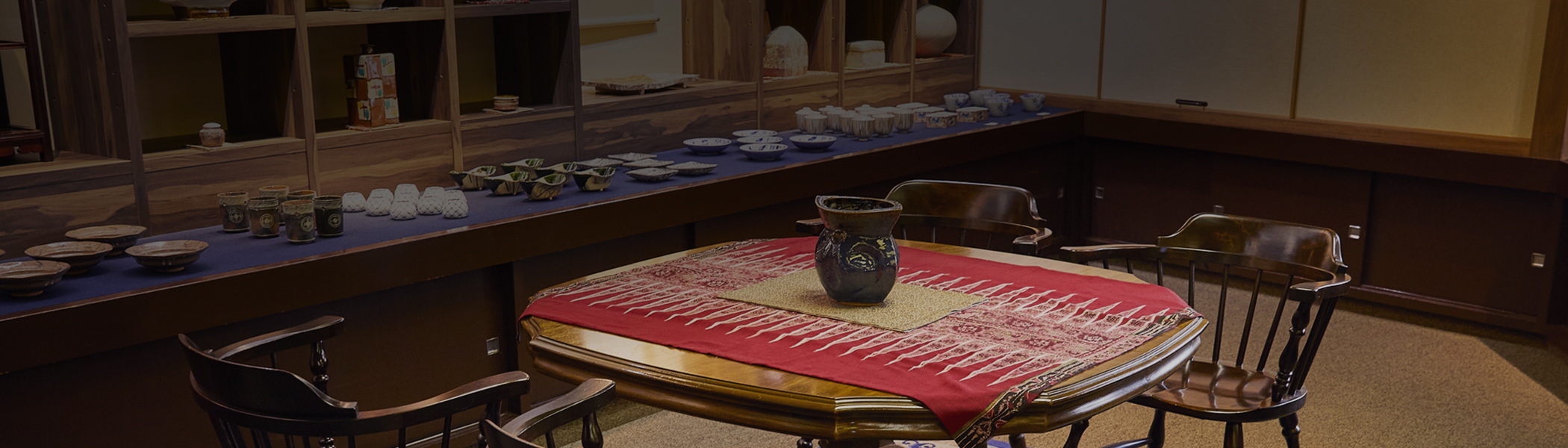
Mushiake-yaki is a type of pottery from Mushiake, Oku Town, Oku District, Okayama Prefecture. It originated during the Kansei era (1789–1801) as the official kiln of the Ikki family, the chief r
The Imperial Household Artist system was established from 1890 (Meiji 23) to 1944 (Showa 19) under the patronage of the Imperial Family, with the purpose of protecting and encouraging the production o
Awata-yaki is a general term for pottery produced around the Awata area in Kyoto’s Higashiyama district. In modern times, while Kiyomizu-yaki primarily focuses on porcelain, Awata-yaki mainly co
Kohiki is a ceramic technique in which a white slip (a muddy porcelain clay) is applied as a decorative coating (also called white slip or white slip coating) onto the clay body, which is then bisque-
Sueki refers to blue-gray, hard-fired earthenware produced using firing techniques introduced from the Korean Peninsula around the middle of the Kofun period (early 5th century). Prior to this, Japan
A type of iron glaze characterized by a low iron content in the iron-bearing clay and minerals, resulting in a dark brownish-black color with a yellowish tint. Unlike other iron glazes, ame-yu is less
The Jun kiln refers to a historical Chinese kiln site active from the Northern Song dynasty through the Jin and Yuan dynasties. Its name comes from its location in Junzhou, present-day Henan Province.
Sansai refers to a type of low-fired earthenware decorated with multiple lead-based glazes. The technique was perfected during the Tang dynasty. The most vibrant examples, known as Tang Sansai (Tang t
Shinza is the Japanese term for a type of red glaze or underglaze decoration achieved using copper oxide as a colorant and firing in a reduction atmosphere. It includes both a red glaze made entirely